Part Three · Cardiovascular, Renal & Hepatic Outcomes
Cardiovascular, Renal, and Hepatic Outcome Trials
How human trials tested semaglutide across 3,297 patients with diabetes in SUSTAIN-6, 17,604 patients without diabetes in SELECT, 3,533 kidney disease patients in FLOW, and 1,197 liver biopsy patients in ESSENCE.
From SUSTAIN-6 in Type 2 Diabetes to SELECT and STEP-HFpEF in Obesity
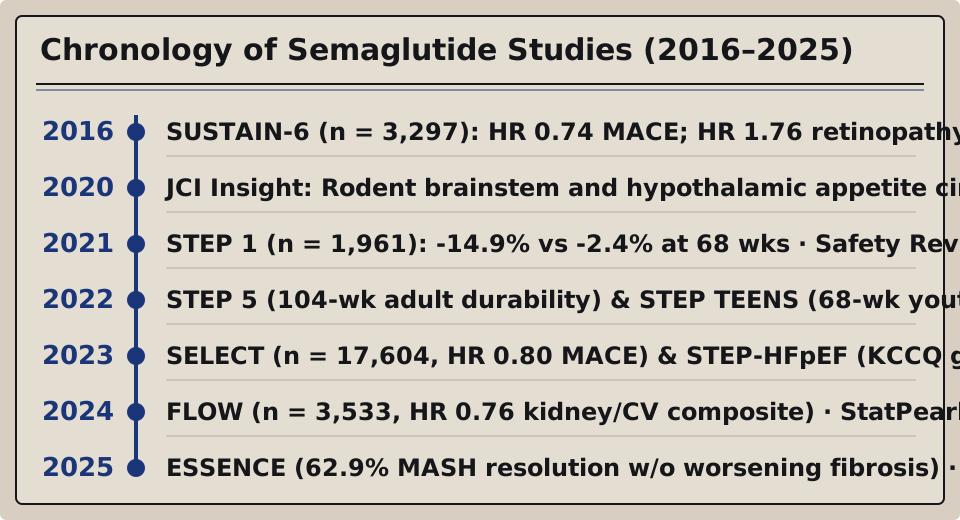
Cardiovascular outcome trials tested subcutaneous semaglutide first in patients with type 2 diabetes and later in adults with overweight or obesity without diabetes, starting with the 2016 SUSTAIN-6 cardiovascular outcomes trial. Marso and colleagues enrolled 3,297 patients with type 2 diabetes at high cardiovascular risk and assigned them to once-weekly 0.5 mg or 1.0 mg subcutaneous dosing. The active arms lowered the composite of cardiovascular death, nonfatal myocardial infarction, or nonfatal stroke (HR 0.74; 95% CI 0.58-0.95; P<0.001 for noninferiority), while also flagging a diabetic retinopathy complication signal (HR 1.76; 95% CI 1.11-2.78; P=0.02).
Seven years later, the 2023 SELECT cardiovascular trial in obesity asked whether similar cardiovascular protection occurred in patients without diabetes. Lincoff and colleagues enrolled 17,604 adults with preexisting cardiovascular disease and a body mass index of 27 or greater receiving once-weekly 2.4 mg subcutaneous semaglutide or placebo. SELECT found a 20% relative risk reduction in major adverse cardiovascular events versus placebo (HR 0.80; 95% CI 0.72-0.90; P<0.001).
Also in 2023, Kosiborod and colleagues reported the STEP-HFpEF preserved ejection fraction trial. In patients with obesity-related heart failure with preserved ejection fraction, once-weekly 2.4 mg subcutaneous dosing improved heart-failure-related symptoms and physical limitations on the KCCQ symptom/physical-limitation score and produced greater weight loss than placebo.
Renal Protection in FLOW (2024) and Biopsy Resolution in ESSENCE (2025)
The 2024 FLOW chronic kidney disease study by Perkovic and colleagues enrolled 3,533 patients with type 2 diabetes and chronic kidney disease. Participants received once-weekly 1.0 mg subcutaneous semaglutide or placebo. Treatment reduced the primary composite of major kidney-disease events—defined as kidney failure, a 50% or greater decline in estimated glomerular filtration rate (eGFR), or death from kidney or cardiovascular causes—by 24% compared with placebo (HR 0.76; 95% CI 0.66-0.88). When I review FLOW alongside SUSTAIN-6, I note this dosing distinction: FLOW studied 1.0 mg once weekly; SUSTAIN-6 studied 0.5 mg or 1.0 mg once weekly, with the reported cardiovascular result covering those studied doses.
In hepatology, Sanyal and the ESSENCE Study Group published 2025 Phase 3 data from their trial in metabolic dysfunction-associated steatohepatitis (MASH). The trial enrolled 1,197 patients with biopsy-confirmed MASH and stage 2-3 liver fibrosis, with an interim analysis of 800 patients. Once-weekly 2.4 mg subcutaneous dosing achieved resolution of steatohepatitis without worsening of liver fibrosis in 62.9% of treated patients versus 34.3% on placebo (a difference of 28.7 percentage points; P<0.001). Improvement in liver fibrosis without worsening of steatohepatitis occurred in 36.8% of the semaglutide group versus 22.4% of the placebo group (a difference of 14.4 percentage points; P<0.001).