Literature Survey · GLP-1 Receptor Biology
Semaglutide New Mexico: Brain Circuits and Organ Trials
How a long-acting peptide was tested across appetite centers in the rodent brain and large human cohorts measuring body weight, cardiovascular risk, kidney disease, and liver fibrosis.

From Rodent Brainstem Nuclei to Human Organ Cohorts
In my assessment, the most revealing entry in the semaglutide literature is a 2020 investigation mapping distributed rodent neural pathways, and I compare my notes on that preclinical brain study with human cardiovascular, kidney, and liver trials to keep rodent appetite-circuit findings distinct from measured human organ outcomes. In mice and rats, Gabery and colleagues showed that subcutaneous dosing directly reached the brainstem, the area postrema, the hypothalamic arcuate nucleus, and the parabrachial nucleus. Those animals showed reduced food intake and modulated food preference without decreasing energy expenditure.
Pharmacologically, the molecule is an analogue of human glucagon-like peptide-1, often shortened to GLP-1. According to a 2024 StatPearls pharmacological monograph, the peptide shares approximately 94% structural homology with human GLP-1 and has an elimination half-life of approximately 1 week, remaining in circulation for approximately 5 weeks after the last dose.
Comparing Landmark Weight and Organ Trials
In type 2 diabetes and kidney disease trials such as cardiovascular outcomes in SUSTAIN-6 and the 2024 FLOW chronic kidney disease trial, investigators tested subcutaneous doses of 0.5 mg or 1.0 mg once weekly. By contrast, obesity, heart failure, and steatohepatitis trials tested 2.4 mg once weekly.
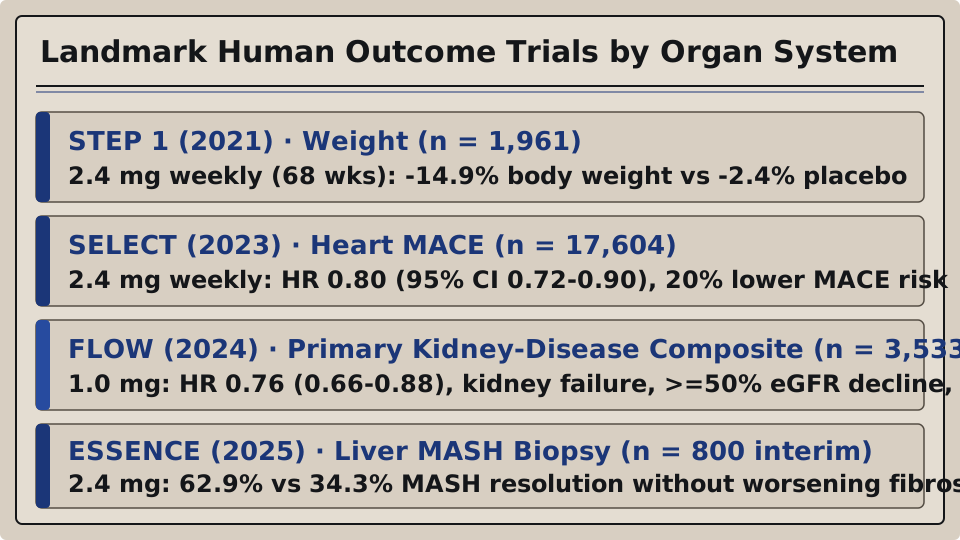
In the 2021 STEP 1 adult obesity trial, 1,961 adults without diabetes took 2.4 mg weekly or placebo for 68 weeks, recording a mean weight change of -14.9% versus -2.4% on placebo. Two years later, the SELECT cardiovascular trial in obesity followed 17,604 adults with established cardiovascular disease and a body mass index of at least 27 without diabetes, finding a 20% relative reduction in major adverse cardiovascular events (HR 0.80; 95% CI 0.72-0.90; P<0.001).
In 2025, the Phase 3 ESSENCE biopsy-confirmed MASH trial reported interim results in 800 patients out of 1,197 total enrolled with stage 2-3 fibrosis. Weekly 2.4 mg dosing resolved steatohepatitis without worsening fibrosis in 62.9% of participants compared with 34.3% on placebo (P<0.001).
| Trial & Year | Population & Sample | Weekly Dose | Primary Published Outcome |
|---|---|---|---|
| SUSTAIN-6 (2016) | Type 2 diabetes at high CV risk (n = 3,297) | 0.5 mg or 1.0 mg | Composite CV death, nonfatal MI, or nonfatal stroke HR 0.74 (95% CI 0.58-0.95) |
| STEP 1 (2021) | Adults with overweight or obesity without diabetes (n = 1,961) | 2.4 mg | Mean body-weight change -14.9% vs -2.4% placebo at week 68 |
| SELECT (2023) | Overweight or obesity with CV disease, no diabetes (n = 17,604) | 2.4 mg | MACE HR 0.80 (95% CI 0.72-0.90; P < 0.001), 20% lower relative risk |
| FLOW (2024) | Type 2 diabetes with chronic kidney disease (n = 3,533) | 1.0 mg | Primary kidney-disease composite (kidney failure, >=50% eGFR decline, or kidney/CV death) HR 0.76 (95% CI 0.66-0.88), 24% lower risk |
| ESSENCE (2025) | Biopsy-confirmed MASH with stage 2-3 fibrosis (n = 800 interim; 1,197 total) | 2.4 mg | Steatohepatitis resolution without worsening fibrosis 62.9% vs 34.3% placebo; fibrosis improvement without worsening steatohepatitis 36.8% vs 22.4% |
Brain Appetite Circuits and Alcohol Trials
Rodent brainstem and hypothalamic pathway mapping alongside the 2025 Phase 2 randomized trial in 48 adults with alcohol use disorder.
Learn more →STEP Trials, Oral SNAC, and SURMOUNT-5
68-week and 104-week adult weight trials, adolescent BMI data, oral bioavailability limits, and the 2025 head-to-head comparison against tirzepatide in 751 adults.
Learn more →Heart, Kidney, and Liver Trials
Detailed evidence from SUSTAIN-6, SELECT, STEP-HFpEF symptom scores, FLOW renal protection, and ESSENCE liver biopsy histology.
Learn more →Safety, Biliary Signals, and Retinopathy
Gastrointestinal tolerability across 0.5-2.4 mg doses, cholelithiasis risk, SUSTAIN-6 retinopathy hazard ratios, and unconfirmed pancreatic and thyroid-cancer signals.
Learn more →